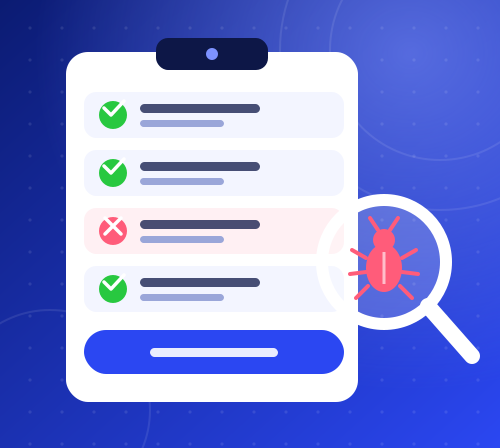
Manual testing
Exploratory and scripted testing that catches problems automation tends to miss.


We test software the way real people use it, and the way attackers and heavy traffic will stress it. You get clear, reproducible findings and the confidence to release.
Realistic scenarios across devices, browsers and roles.
Repeatable checks that run on every change.
Steps, evidence and severity that developers can act on.
Testing starts with requirements, not the day before launch.
Combine the types of testing your product needs, or let us design a plan for you.
Exploratory and scripted testing that catches problems automation tends to miss.
Reliable automated suites for regression, smoke and end-to-end checks.
Verify endpoints, data contracts, error handling and integrations.
See how your system behaves under heavy use, and where it starts to slow.
Checks for common vulnerabilities such as injection, broken access and weak sessions.
Coverage across devices, operating systems, networks and screen sizes.
Make sure new changes do not break features that already work.
Test plans, tooling advice and process improvements for your team.
Knowing what matters in your sector makes tests more meaningful.
We join your team early and keep testing close to development, where problems are cheapest to fix.
Talk to our teamWe review requirements and design with testing in mind, catching issues before code exists.
Automated tests run on every build and give fast feedback to developers.
Effort goes where failure would hurt most, not evenly everywhere.
Dashboards show coverage, defect trends and release readiness at a glance.
Testers and developers work together, not at odds.
A fresh set of eyes that is not attached to the code being tested.
We choose tools that match your stack and that your team can maintain afterwards.
Testing is planned, repeatable and reported clearly at every stage.
We study requirements, risks and the product to understand what must be proven.
We define scope, test types, environments, data and entry and exit criteria.
We write test cases and automation scripts that map to requirements and risks.
We run tests, log defects with clear evidence and verify fixes as they land.
We share results, assess release readiness and refine the approach each cycle.
From a single release to a long-term QA partnership.
Testing for a specific release or project.
We own test planning, execution and reporting.
QA engineers who work inside your sprints.
As early as possible. Reviewing requirements and designs for gaps costs far less than fixing defects after the code is written, so we like to be involved from the beginning.
No. Automation is excellent for repetitive checks like regression, while manual and exploratory testing is better for new features and usability. We recommend a balance that suits your product.
Yes. We regularly test applications built by other teams and provide an independent assessment of quality and risk.
Each defect includes steps to reproduce, expected and actual results, severity and supporting evidence such as screenshots or logs, logged in your tracker.
Yes. We combine real devices with emulators and cloud device labs to cover the browsers, operating systems and screen sizes your users have.
Yes. Our testers join sprint planning, test stories as they are completed and share results in your regular reviews.
Tell us about your product. We will suggest a testing approach and offer a free IT consultation.
Book a Free IT Consultation